Tiếng Việt
A phono cartridge is the electromechanical transducer mounted on a turntable tonearm: the stylus tracks the vinyl groove, vibration travels through the cantilever and becomes an electrical signal, then passes through a phono stage to your amplifier. Choosing the right cartridge largely defines vinyl sound, even if the deck or speakers cost more. Overview on District M’s turntable page.
Quick summary: Start with MM if your phono only supports MM (common on entry decks). MC can sound more detailed but needs MC phono or a step-up. Check tracking force, compliance, and cartridge weight match the tonearm. Upgrade path from entry: Ortofon 2M Red → Blue → Black, or Nagaoka MP-110. Always set tracking force after installation.
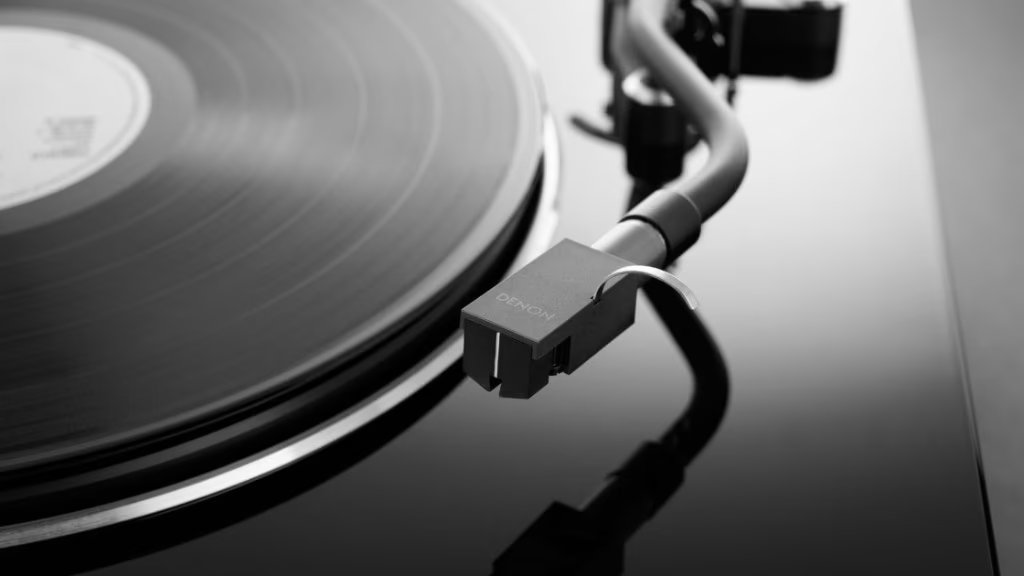
What is a cartridge and why does it matter?
In the vinyl playback chain, all audio information starts at the stylus contacting the groove. A cartridge combines stylus, a fine cantilever, and a generator (magnet + coil or the reverse). A poor, worn, or misaligned cartridge limits detail and clarity no matter how good the amp and speakers are.
Many decks ship with entry cartridges (AT3600L, Pick it MM E, OM5e, etc.). Once you know your system, swapping the cartridge is often the most effective upgrade before replacing the whole turntable. See also basic turntable knowledge and cartridge guide part 2 on District M Magazine.
Types: Moving Magnet (MM) and Moving Coil (MC)
Both MM and MC convert mechanical vibration to electricity; they differ in whether the magnet or coil moves:
- MM (Moving Magnet): magnets on the cantilever move; coils are fixed. Output is usually 3-6 mV, easy to pair with standard 47 kΩ MM phono.
- MC (Moving Coil): coils on the cantilever move; magnets are fixed. Output is usually 0.2-0.5 mV (low output) or higher on some high-output models.
| Criteria | MM | MC |
|---|---|---|
| Output | High (3-6 mV) | Low (usually < 1 mV) |
| Phono needed | MM / built-in deck phono | MC or step-up transformer |
| Stylus swap | Easy (many lines) | Usually replace full cartridge |
| Entry cost | Lower | Higher |
| Sound (same price) | Warm, easy listening | Often cleaner, more detailed |
| Best for | Beginners, existing MM systems | Audiophiles, dedicated MC phono |
More detail: MM vs MC cartridges. MC needs a suitable phono preamp – not a normal line input.
Six criteria for choosing a cartridge
Check each item before buying. Skipping any step risks a mismatch or suboptimal setup:
| Criterion | What to check |
|---|---|
| MM vs MC | What does phono on the deck, amp, or external box support? |
| Tracking force (VTF) | 1.5-2.0 g is common; balance counterweight after install |
| Compliance | Soft (high compliance) suits light arms; stiff cartridges suit heavier arms |
| Weight | Total cartridge + headshell within arm limits (often 5-12 g) |
| Stylus | Spherical (entry) → elliptical → nude elliptical / line contact (premium) |
| Budget and goal | Musical warmth or analytical detail? Main genres? |
Stylus shapes: spherical, elliptical, line contact
Stylus profile directly affects detail and record wear:
- Spherical (conical): least groove contact, less detail, common on cheap entry styli.
- Elliptical: wider contact, good price/detail balance (2M Red, VM95E).
- Nude elliptical / fine line / Shibata: deeper contact, needs careful setup but reads more groove info (2M Blue, 2M Black).
Sharper, higher-contact styli cost more and are sensitive to wrong tracking force. Beginners should favor stable elliptical before moving to line contact.
Compliance and tonearm: match them
Compliance (µm/mN) describes cantilever stiffness. Light, short arms usually suit high compliance (15-25 µm/mN). Heavy, long arms (9-12″) often suit lower compliance. A mismatch can cause loose bass, resonance, or early record wear. If unsure, ask District M with your deck and arm model.
Phono stage: do not skip it
Cartridge output is too small for a line input. You need a phono stage with RIAA equalization. Many entry decks have built-in MM phono; moving to MC often means upgrading phono too. See Pro-Ject Phono Box DC for an external MM entry phono.
Cartridge picks by tier at District M
Common directions in stock or on request at turntable accessories. Prices and stock change – contact us before ordering.
Entry MM: Audio-Technica VM95 and Nagaoka MP-100
Audio-Technica AT-VM95E (and the VM95 family) fits decks with VM95 bodies: easy stylus swaps, entry pricing. Nagaoka MP-100 is a warm, smooth Japanese MM – a clear step up from bundled budget styli.
Mid MM: Ortofon 2M and Nagaoka MP-110
The Ortofon 2M line is a familiar upgrade ladder on mainstream decks:
- Ortofon 2M Red: well-rounded entry MM, elliptical, 5.5 mV output.
- Ortofon 2M Blue: nude elliptical, more detail and space than Red.
- Ortofon 2M Black: nude Shibata, Ortofon MM flagship for serious systems.
Nagaoka MP-110 is another strong mid MM: warm, full bass, great for jazz, vocals, and classic rock.
| Criteria | 2M Red | 2M Blue |
|---|---|---|
| Stylus | Elliptical | Nude elliptical |
| Output | 5.5 mV | 5.5 mV |
| Tracking force | 1.8 g | 1.8 g |
| Tier | Entry / first upgrade | Mid, step up from Red |
Classic MC: Denon DL-103 and DL-110
Denon is known for Japanese studio MC cartridges. Denon DL-103 is a low-output MC legend: smooth, warm mids, needs quality MC phono. Denon DL-110 is high-output MC, easier to pair with MM phono than traditional DL-103. Both target stable systems ready to explore MC.
Other brands worth considering
Sumiko (Pearl, Rainier) and Hana (EH, SL) are well regarded for balanced MM/MC performance. District M can advise on special orders. Clearaudio, Gold Note, and other MC lines appear in accessories when in stock.
Common mistakes when choosing or installing
- Buying MC with MM-only phono: too quiet or distorted sound.
- Skipping tracking force setup: too light → skipping; too heavy → record and stylus wear.
- Budgeting cartridge only, not phono: MC without MC phono budget wastes money.
- Compliance mismatch: uncontrolled bass or missing detail.
- Not replacing worn styli: dull, distorted sound and groove damage while it still “plays”.
After a new cartridge, listen to familiar tracks at moderate volume and recheck tracking force after 10-20 hours (some arms need a slight tweak).
Who should choose what?
Beginners / decks with MM phono: keep entry MM or step up to Ortofon 2M Red, Nagaoka MP-100/110, VM95E. Mid decks wanting more detail: 2M Blue or 2M Black. Trying MC: start with high-output MC (DL-110) or budget MC phono before DL-103. Plug-and-play decks with fixed styli: pick the right deck first instead of investing in a separate cartridge.
Full turntable + accessory path: vinyl A-Z guide 2026.
FAQ
MM or MC for beginners?
MM in most cases: works with entry deck phono, easy stylus replacement, lower entry cost than MC.
Is 2M Blue worth upgrading from Red?
2M Blue has nude elliptical, more detail and space than Red at the same 1.8 g tracking force. Worth it if you know Red and want a clear step up.
Do I need to realign the arm after swapping cartridges?
Yes. Each cartridge differs in weight and recommended tracking force. Balance counterweight, set anti-skate, and check azimuth if possible.
My deck has no phono – what after buying a cartridge?
You need an MM or MC phono stage, or an amp with phono input. Cartridge output cannot plug straight into line-in.
How often should I replace the stylus?
Typically 500-1000 hours depending on stylus type, tracking force, and record cleanliness. Dull sound, distortion, or sibilance sizzle often means wear.
Cartridge specs reference Ortofon, Nagaoka, Denon, Audio-Technica. Models and stock at District M may change.
Conclusion
Choosing a cartridge is straightforward once you know MM vs MC, your current phono, and tonearm limits. Start safely with an MM that fits your budget, set tracking force correctly, then upgrade as you hear the system’s limits. The right stylus not only improves sound but helps you rediscover your record collection from a new angle.
Cartridge advice at District M
Recommendations based on your deck, phono, and listening genres.