Tiếng Việt

Have you ever wondered how tiny vibrations in a vinyl groove become music? The answer lies in the phono cartridge – a small part that largely defines the sound quality of your entire analog system.
In the analog world, cartridges fall into two main types: MM (Moving Magnet) and MC (Moving Coil). Each has its own construction, operating principle, and sonic character. This guide explains the differences so you can choose what fits your needs and budget.
Quick Summary
| Criteria | MM cartridge | MC cartridge |
|---|---|---|
| Construction | Magnets on the cantilever, fixed coils | Coils on the cantilever, fixed magnets |
| Output level | High (3-5 mV) | Low (0.2-0.5 mV) |
| Stylus replacement | Stylus can be replaced separately | Stylus not replaceable; replace entire cartridge |
| Price | Lower, wide range of tiers | Higher, mostly premium segment |
| Sound | Warm, lively | Detailed, refined, quiet background |
| Best for | Beginners, moderate budgets | Audiophiles, high-end systems |

1. What Is a Phono Cartridge? Parts and Role
Before comparing MM and MC, here is the basic anatomy of a cartridge:
Vinyl grooves that hold the audio information are extremely small – about 0.04-0.08 mm wide – and can total up to 500 m of groove length on one record. The stylus tracks those grooves and converts mechanical vibration into an electrical signal.
A typical cartridge has three main parts:
-
Stylus: The tip that contacts the groove, usually diamond or sapphire. Sharper profiles that read more of the groove cost more.
-
Cantilever: The link between stylus and cartridge body, transmitting vibration to the generator section.
-
Cartridge body: Houses the magnet and coil system where the electrical signal is generated.
Tip – Lifespan: On average, replace an MM stylus after 1,500-2,000 hours of use due to wear. MC cartridges do not allow stylus-only replacement, so you replace the whole unit.
Both MM and MC work on electromagnetic induction: when a conductor moves in a magnetic field, it generates current.
As the stylus moves in the groove, vibration travels through the cantilever to the generator (magnet or coil). That motion in the magnetic field creates the raw audio signal, which is sent to a phono stage for amplification to a level your amp and speakers can use.
The MM vs MC difference is in the generator layout: what moves and what stays fixed.

3. MM (Moving Magnet) Cartridges
Construction
-
Two small magnets (one per channel) mounted at the end of the cantilever.
-
Coils fixed inside the cartridge body, positioned around the magnets.
How It Works
When the cantilever moves, the magnets move with it. Magnet motion inside the fixed coils generates the induced current.
Key Traits
| Pros | Cons |
|---|---|
| High output (3-5 mV), works with standard MM phono stages | Heavier moving mass at the tip; slower response than MC |
| Replaceable stylus saves cost over time | Less fine detail than MC |
| Wide price range from entry to high-end | More prone to resonance effects |
| Durable and less sensitive to environment |
Who Is MM For?
-
New vinyl listeners
-
Low to mid budgets
-
Systems with built-in MM phono in amp or active speakers
-
Listeners who prefer warm, lively sound

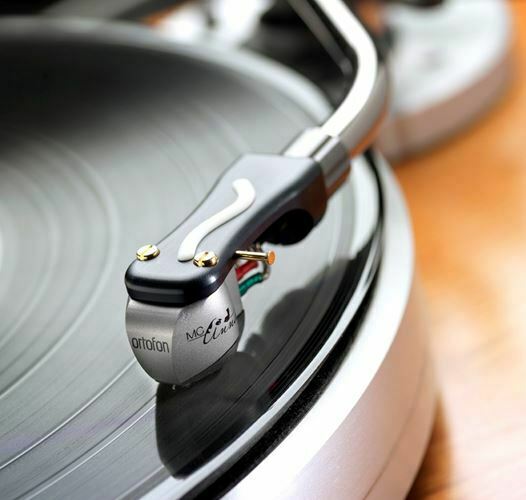
4. MC (Moving Coil) Cartridges
Construction
-
Ultra-fine coils mounted directly at the end of the cantilever.
-
Magnet system fixed inside the cartridge body.
How It Works
When the cantilever moves, the tiny coils move within the fixed magnetic field, generating induced current.
Key Traits
| Pros | Cons |
|---|---|
| Very low moving mass; faster, more delicate tracking | Very low output (0.2-0.5 mV); needs MC phono stage or step-up transformer |
| Less affected by resonance | No separate stylus replacement; full cartridge swap when worn |
| High detail, quiet and transparent sound | Significantly more expensive than MM |
| Better high-frequency extension | Complex build; more demanding setup |
Who Is MC For?
-
Experienced audiophiles
-
High-end, well-matched systems
-
Ready to add a dedicated MC phono stage or step-up transformer
-
Listeners chasing maximum detail from vinyl
5. MM vs MC: Which Should You Choose?
Detailed Comparison
| Criteria | MM | MC |
|---|---|---|
| Moving element | Magnet | Coil |
| Moving mass | Heavier | Very light |
| Output level | High (3-5 mV) | Low (0.2-0.5 mV) |
| Phono stage required | Standard MM phono | MC phono or step-up transformer |
| Stylus replacement | Yes, separately | No – replace full cartridge |
| Detail | Good | Excellent |
| Background noise | Average | Low |
| High-frequency response | Good | Outstanding |
| Price | Budget to mid | High to very high |
| Maintenance | Easy | More careful handling |
| Typical lifespan | 500-800 h (stylus swap) | 1,000+ h (full cartridge) |
Choose by Need
Choose MM if:
-
You are new to vinyl
-
Your cartridge budget is entry to mid-range
-
Your amp or active speakers only have MM phono input
-
You want easy stylus replacement later
-
You prefer warm, easy-listening sound
Choose MC if:
-
You have experience and want to upgrade
-
Your budget supports a premium cartridge
-
You will invest in a dedicated MC phono stage
-
You want maximum detail and refinement
-
The rest of your system can reveal those fine details
Advice: Do not rush into MC if the rest of your system (amp, speakers) is not ready. A quality MM in a balanced setup often sounds better than a cheap MC on a system that cannot keep up.
Conclusion
Understanding MM vs MC is an important step toward building a turntable system that fits your goals and budget.
-
MM is the practical choice for most listeners, especially beginners.
-
MC is for enthusiasts willing to invest for the highest detail and refinement.
Remember: the cartridge is only one part of the chain. A good stylus needs a compatible tonearm, the right phono stage, and speakers capable of showing what it can do.